
Build blueprint
The decisions behind the UI — with real examples.
Switch tabs to see what we built and why it works for this specific domain.
Examples
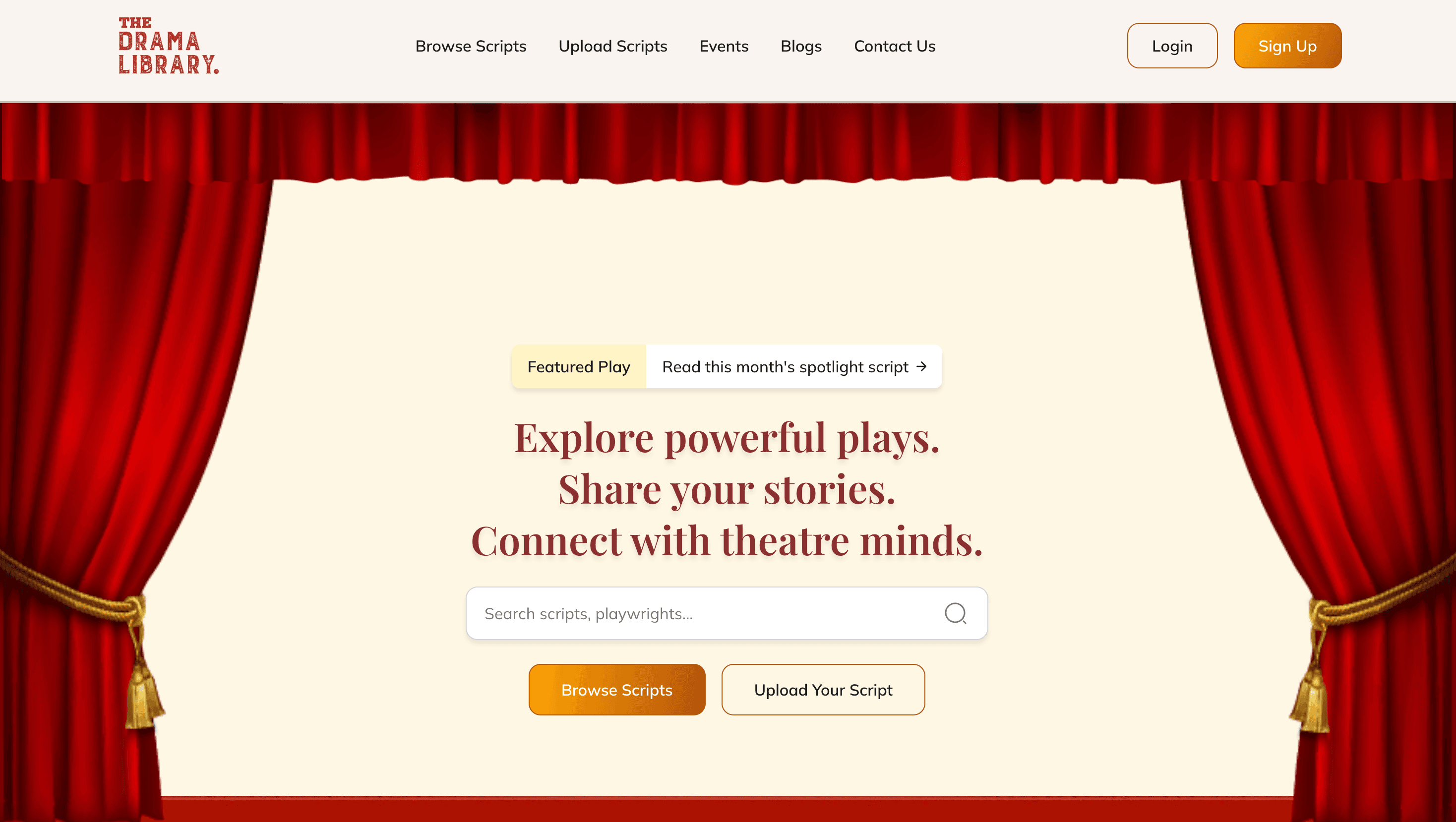
Dual-intent funnel
Reader vs Creator flows are split early.
Browse Scripts
Fast entry for readers to explore.
Upload Your Script
Clear path for playwright submissions.
Featured play
Spotlight module to guide discovery.
Context
Who it’s for, and what changed.
Users
Constraints
Problem
The friction we removed.
TDL needed a modern portal that makes it easy to discover plays (featured scripts + browsing), while building community trust and enabling content operations behind the scenes.
Outcomes
- Clear entry points for reader vs creator flows
- Featured content to guide discovery
- Trust-building through community testimonials + newsletter loop
- Admin surface for consistent content operations
Solution
The approach.
A portal-style landing with clear entry points (Browse Scripts / Upload), a featured spotlight, and trust-building modules (community testimonials, newsletter), paired with an admin panel for content operations.
Build notes
- Public site optimized for discovery flows
- Admin tooling structured around repeatable workflows
- Accessible layouts with consistent spacing and type scale
UX patterns
Design decisions that scale.
These patterns make the experience predictable under stress—whether it’s content discovery or day‑to‑day ops.
- Hero with dual CTAs (Browse / Upload) to split user intents
- Featured play spotlight module
- Featured scripts section (future: cards + pagination/search)
- Community proof block (testimonials) to reduce trust friction
- Newsletter subscription as retention loop
- Admin dashboard: workflow-first operations (status, actions, content management)
Typography
Readable = credible.
Geist (Sans) with deliberate hierarchy
Keeps long-form content readable while supporting modern UI elements for portal workflows.
UI system
Color + spacing discipline.
High-contrast content surfaces with warm accents to support the brand’s cultural tone without sacrificing readability.
Screenshots
What shipped.
Click to zoom.
Next
What we’d do next.
Tighten the workflow
Audit friction points and reduce steps for the key conversion/ops paths.
Make the system faster
Performance budgets, image strategy, and key-path caching for speed.
Scale with a design system
Tokenize spacing/type, build reusable components, prevent drift.
Start a conversation
Ready to talk about your next release?
Share where your product is today and where it needs to be in the next 6–12 months. We'll respond with a thoughtful point of view—not a canned pitch.
- 01
Share context
Where you are and what’s next
- 02
Get a point of view
Ideas, risks, and options
- 03
Shape the engagement
Scope, squad, and timeline
- Reply within 1–2 business days
- No generic sales deck
- NDA available on request
Prefer email? Use our contact page · hello@simegh.com
Project brief
~2 minutes · we read every submission